Sustainable Water Management- Daniela Barrera

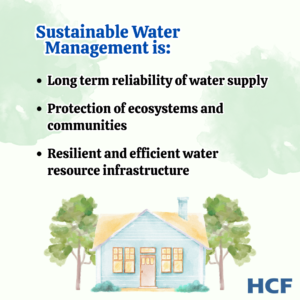
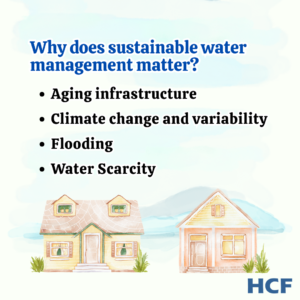
Water is one of our most important resources and managing it sustainably means planning not just for today, but for the future. Sustainable water management considers the entire water system.
From our natural resources and infrastructure to our communities and future water demands. Looking ahead helps us build more resilient water systems for generations to come.

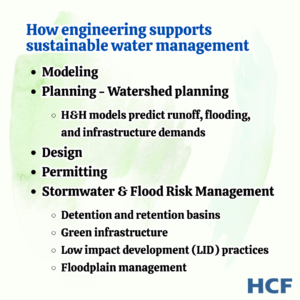
Scroll to learn why sustainable water management matters and how engineering makes it possible.
 

2D Water Modeling – HCF Lunch & Learn

Bryson Price, a Certified Floodplain Manager (CFM) and a water resources EIT, led a company-sponsored Lunch & Learn on 2D hydraulic modeling in HEC-RAS (Hydrologic Engineering Center’s River Analysis System). He broke down how this advanced simulation method divides landscapes into grid-like cells to show how water flows across terrain. With detailed animations and real-world examples, Bryson explained how 2D models offer more nuanced and accurate results, perfect for complex floodplain analysis. HEC-RAS is the most common tool used for flood mapping, dam breaches, and bridge scour, offering flexible, multi-sided computational cells to map flow over complex terrain. Thanks to Bryson for making a complex topic both accessible and engaging!💧💧💧

Sediment Transport in Stream Design – HCF Lunch & Learn

We recently had the pleasure of learning from our water resources engineer, Easton Perkins, EIT, during a company-sponsored Lunch & Learn. He shared insights from a Sediment Transport course he took through Utah State University‘s Department of Watershed Sciences. He highlighted how rivers shape themselves—and how engineers can design with nature in mind. A great reminder that understanding critical processes leads to more resilient, sustainable solutions.

We recently had the pleasure of learning from our water resources engineer, Easton Perkins, during a company-sponsored Lunch & Learn. He shared insights from a sediment transport course he took through Utah State University’s Department of Watershed Sciences. He highlighted how rivers shape themselves—and how engineers can design with nature in mind. A great reminder that understanding critical processes leads to more resilient, sustainable solutions.